
Three ways to play. All of them run on the same economy, the same two factions and the same rules — what changes is who's on the other side.
Skirmish vs. AI
Add a SimpleAI opponent for a standard one-on-one. It plays a conventional game — builds an economy, produces an army, attacks. It's the right way to learn the fundamentals without a human opponent noticing every mistake. Mirror matchups collapse into positioning and economy, which is an excellent way to learn without a faction puzzle on top.
SurvivalAI: wave defence
SurvivalAI is co-operative wave-based survival, and it's an excellent way to learn because it removes the "what is my opponent doing?" problem while keeping every economic and defensive lesson intact. A team of players can share a survival map and hold the line together — an experienced player handles the pressure while a newcomer learns the economy without being eliminated for a mistake.
The convention is one SurvivalAI per player, but it's entirely optional: three players against one is a gentle game, four against four is a serious one.
How it works
The AI operates from beacon units — its spawn points and command structures. Waves emerge from them, escalating over time. Each wave has a character, and reading it tells you what defence you need:
| Archetype | What comes | What you need |
|---|---|---|
| Assault | Straightforward line units, head-on | Solid front-line defence |
| Raid | Fast units aiming for your economy | Coverage on flanks and expansions |
| Siege | Long-range units outranging static defence | Mobile units to go kill them |
| Air | Aircraft ignoring your ground defence | Anti-air, before it arrives |
| Drop | Forces delivered behind your lines | Interior defence and a reaction force |
| Horde | Overwhelming numbers of cheap units | Area damage, chokepoints |
Beacon specialisation
Beacons aren't identical. They take on roles that make the waves they support meaningfully harder — which creates a target priority list. Killing the right beacon changes the shape of the game.
Shield
Reinforces attacking waves with protection.
Cloaking
Every unit from this beacon arrives cloaked — genuinely invisible until it's on top of you.
Accelerator
Increases wave frequency or speed. Take it out and you get breathing room.
Forge
Improves unit quality. Take it out and the waves get softer.
Garrison turrets defend beacons, so beacon assaults are real operations requiring a real army. Surge waves are telegraphed escalation events — prepare during the lull. And when you reduce the AI to its final beacon, it goes into overdrive. Build up first, then commit fully.
How to play it: economy first, hard — the early waves are gentle deliberately. Build defence to a schedule, not to panic. Cover every approach and check with range rings. Build anti-air before the first air wave. Then go on the offensive: defences don't get repaired, so pure turtling loses eventually. Use the lulls to reclaim, rebuild, expand and push. Downtime spent idle is the mode's real difficulty setting.
Multiplayer
Joining works through the lobby: pick a room, pick a team, ready up.
Hosting has two options, and one of them is much easier.
Use a SPADS autohost
Official autohosts are permanently-running servers that host battles for you. Join one, set up your game through its commands, play. No configuration, no network setup. If you just want to play with friends, use an autohost — it's what most players do anyway.
Host it yourself
Other players connect to you, which means your router has to let them in. You must forward TCP/UDP port 8254 to the machine running the game (changeable on the Host a New Battle screen). Skip this and the battle appears in the lobby and nobody can connect — the single most common hosting problem, and it looks like a bug rather than a setting.
Playing with allies
- Share vision and use it. Between you, you can watch far more of the map than either could alone.
- Share resources when it helps. An ally who's stalled and can't rebuild is a dead ally, and then you're alone.
- Coordinate attacks. Two armies arriving at the same place at different times is two defeats.
- Divide the map. Decide who covers which flank before the game starts.
- Draw, don't type. Hold backtick and an arrow on the map takes half a second. By the time you've typed the warning, it has arrived.
Etiquette: ready up promptly. If you're new, say so. If you must leave early, say so rather than dropping.
Desyncs and crashes
First, check that everyone is on the same game version — Coilbox handles this automatically. If the versions match, please report it: open an issue on the SplinterFaction GitHub repository and attach your infolog.txt and the replay file for the affected match. Those two files together are usually enough to identify the cause; a report without them generally isn't actionable, however detailed the description.
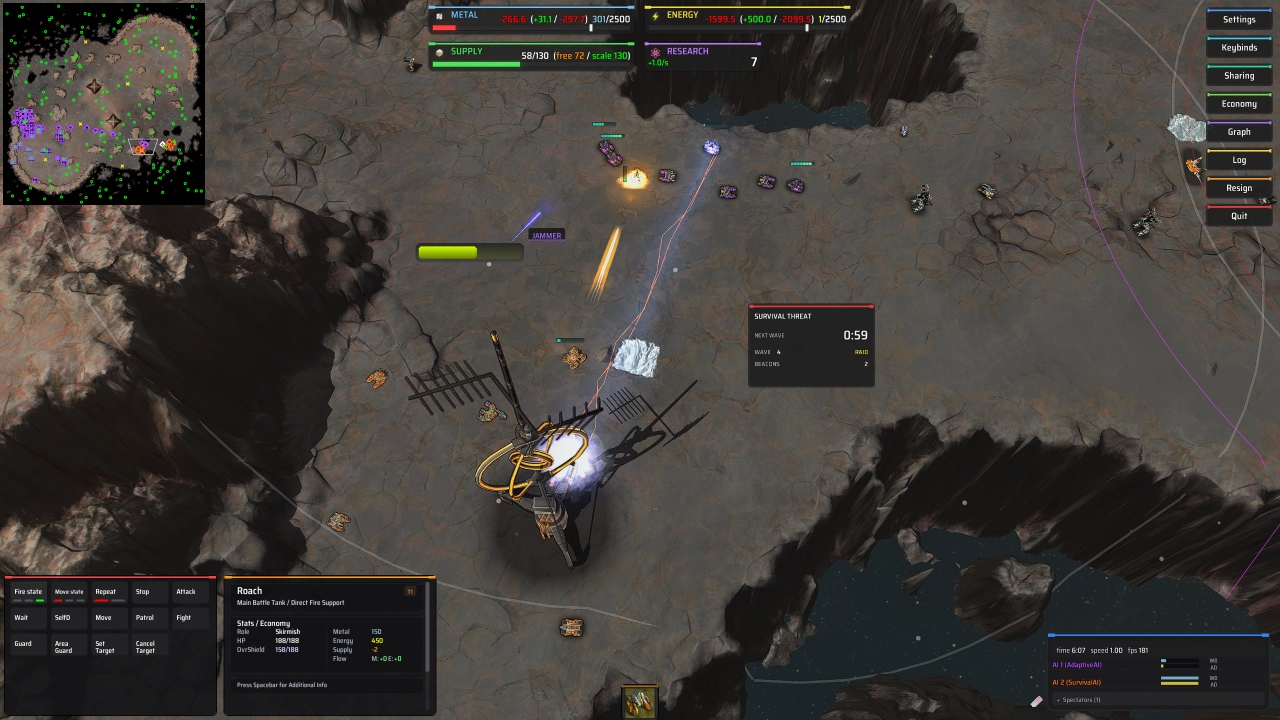 The survival panel and beacon labels overlay
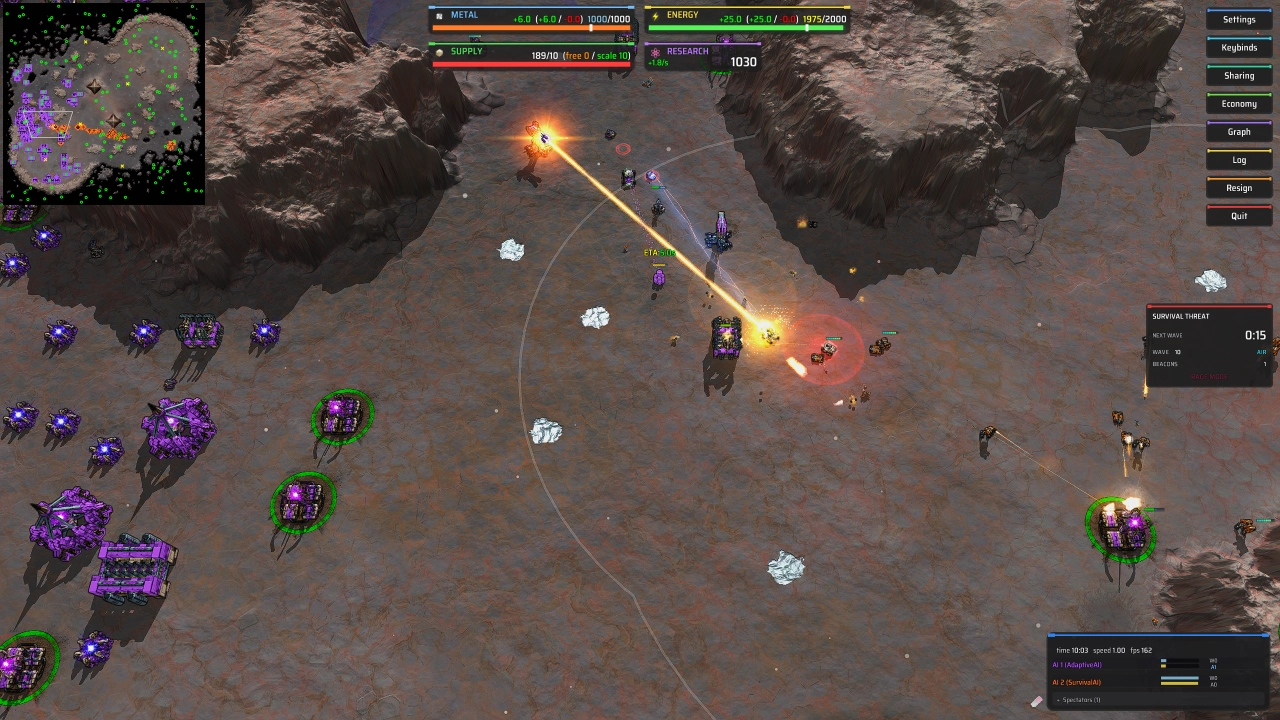 Holding a choke against a horde wave