
Everything in this game reduces to four steps, running continuously and simultaneously. Learn the loop and everything else is decoration.
The loop
Produce
Generate energy, and convert it into metal at fixed resource locations on the map.
Build
Turn those resources into production buildings, then into army.
Expand
Use that army to hold more resource locations, which gives you more income.
Fight
Use the resource advantage to destroy the enemy's ability to do steps 1–3.
That's the genre. Chess with a clock that never stops and a board you're allowed to build more squares on. The critical word is simultaneously: a new player does one thing at a time. A good player never stops doing all four.
A note on the word "gather". Nothing is collected and carried. You build EM Converters on fixed resource locations and they turn energy into metal, continuously, until destroyed. Your metal income is a rate, produced by structures — which means your metal economy and your energy economy are the same problem. The economy, in full.
The snowball
RTS games are systems of compounding advantage. An extra converter built at minute two is not "one converter". It is metal every second for the rest of the game — which becomes an extra unit at minute five, an extra piece of map at minute seven, three more converters, and an army the enemy cannot match at minute fifteen.
- Small early advantages become enormous. Killing one enemy constructor in the first three minutes is worth more than killing five tanks at minute twenty.
- Doing nothing is expensive. Idle constructors, idle factories, unspent income — all of it is compound interest you're refusing to collect.
- Being behind gets worse on its own. If you're losing on economy and change nothing, the gap widens by itself.
Rule of thumb: your stored resources should be roughly zero at all times. Money in the bank is money not working.
Macro and micro
Macro is everything about your economy and production. Am I spending my income? Is my factory idle? Am I ahead on supply? It's boring, invisible, and decides roughly 80% of games.
Micro is moment-to-moment control of units in a fight — pulling a damaged unit back, focusing fire, kiting. It's exciting, visible, and decides roughly 20%.
New players almost universally over-invest in micro. They watch a battle for forty seconds while their base sits doing nothing, win the battle, and lose the game because the enemy built nine more units during those forty seconds. The discipline to learn first: every time a fight starts, glance at your base before you start micromanaging.
Form a concave, not a clump
Units shoot straight through friendlies, so a back rank is never blocked. A concave wins for two other reasons: more of your units are in range of theirs, and one artillery shell hits one or two units instead of eight. Right-click and drag to draw the line, and your army spreads into it in one gesture.
Fight, not Move
A plain Move order sends units walking past enemies while being shot in the back. Fight sends them out ready to engage anything they run into. It's what other games call attack-move, and it's the most important order in the game. Pair it with Set Target and your army focus-fires for you.
Why you lose (and it's almost never combat)
New commanders think they lose battles. They almost never do. They lose one of these:
| What actually happened | What it felt like |
|---|---|
| You floated 4000 metal for six minutes | "Their army was bigger" |
| You were supply blocked and couldn't build units | "I don't know, it just stopped letting me" |
| Your factory was idle for two minutes | "You out-teched me" |
| You never scouted and were surprised | "That was cheesy" |
| You didn't expand past your first few resource locations | "They snowballed" |
| You energy-stalled and everything stopped | "The game bugged out" |
| You attacked into a defended position with no plan | "Their units are overpowered" |
Every entry in the left column is fixable by you, permanently, and none of them require fast fingers. The voice advisor running through every match is a live diagnostic feed on exactly these failures — when it says something, do the thing it said.
Your first five minutes
A concrete, working opening. It isn't the only one, but it's a real one and it will not embarrass you.
1 EM Converter → 2 Fission Power Plants → 1 Factory → 3 Constructors → raiders
One converter, then power immediately — a converter with nothing feeding it is a decoration. Then the factory, because production capacity can't be rushed later. Then three constructors, which is where your economy actually starts. Don't manage them as a pool; give each a standing role:
| Constructor | Job |
|---|---|
| #1 | Nothing but EM Converters. Claim every resource location it can reach. |
| #2 | Nothing but power plants. All game long. |
| #3 | Flex — help grab converter spots, then build defence turrets at vulnerable positions. |
By 3:00 — scout. Non-negotiable. By 5:00 — expand, add supply, keep the factory running. Then, every couple of minutes, the four checks:
- Is my metal near zero? (spending everything)
- Is my factory producing? (never idle — use repeat)
- Am I ahead on supply? (never blocked)
- When did I last look at the enemy? (under three minutes ago)
That list beats most opponents on its own.
Rush, boom, turtle
Three postures. Each beats one and loses to another, and none is stronger — this is deliberate. It's closer to poker than chess: you're playing your opponent, not the optimal line.
Rush
Beats boom · Loses to turtle
Early aggression before defences exist.
Boom
Beats turtle · Loses to rush
Skip early army, maximise economy, overwhelm later.
Turtle
Beats rush · Loses to boom
Heavy defence, hold a small area, tech up.
Turtling differs by faction. Loz cannot turtle indefinitely — nothing repairs a Loz structure, so every wave that hits the line leaves it weaker forever. Fed structures regenerate and healstations repair them, which makes a Fed line a position you can actually hold. Both forgo the research points that kills provide, and neither wins by sitting still.
For new players: aim for the middle. Build economy hard, keep a modest army for safety, one defence at your choke, expand steadily. It beats nothing perfectly and loses to nothing catastrophically, which is what you want while learning.
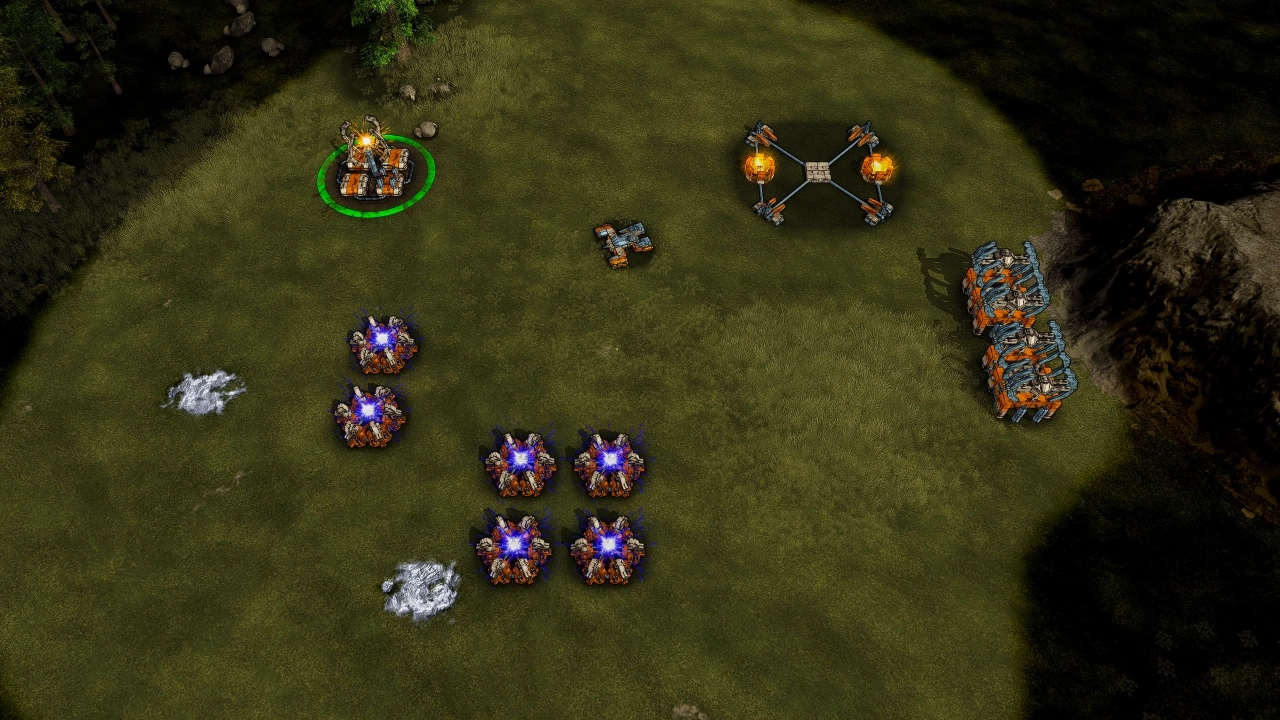 The opening build, laid out
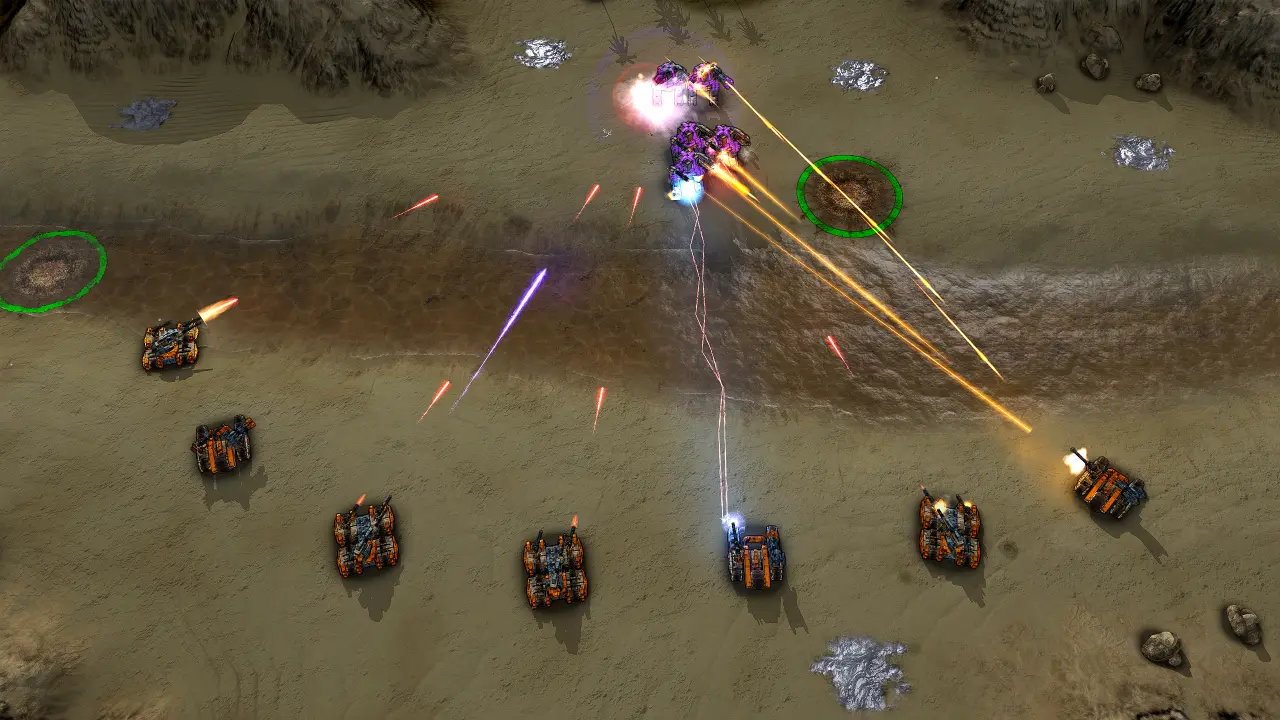 Concave vs. clump