
If you've played other games in the Recoil family, these are the adjustments. If you haven't, these are simply the rules. Either way, they are deliberate, and they reshape how the whole game is played.
The Commander
The Commander is a loss condition, not just a unit. In 1v1, losing it loses you the game immediately, whatever your economy or army. In team games, the match ends when the last Commander on a side is destroyed — and a player who lost theirs keeps every tech level they had, and can never gain another.
It's also your tech tree. The only way to raise your tech level is to upgrade your Commander through four tiers, paid with research points. And it's a weapon: each tier gains range and dramatically more damage. The Fed Commander carries an EMG Disruption Cannon; the Loz Commander a heat ray. A Commander can bully an enemy force off contested ground or hold a choke your army hasn't reached yet — but Commander weapons are mostly ineffective against other Commanders, so don't plan on winning a duel.
The judgment to develop is knowing when to push and when to walk it home. Use it to push, then bring it home. Keep it constructing. Bind it to a control group. And never risk it to build something — there is no structure only the Commander can place.
There is no repair
Constructors build things and reclaim things. They do not fix things. Not units, not structures. A tank that comes out of a fight at 40% stays at 40%. A defensive turret is not a permanent installation; it is a resource that gets used up.
- Every fight has a lasting cost. Count what condition the winner's army is in afterwards, not just who won.
- Trading efficiently is everything. Losing 300 metal of units to kill 500 is a genuine victory even if you "lost the fight" — and those kills paid you in RP.
- Damaged units still have value. Their guns work at full strength. Pull them to the second rank and let the healthy units eat the fire.
- Attrition is lethal. Poking at a defended position and going home to "recover" is a losing pattern. There is no recovery. Either commit, or don't go.
Only two things in the game restore health, and both are faction-specific: Federation hull regeneration and the Federation Healstation. Loz shields recharge, but the hull underneath never does. This asymmetry is the core of the matchup.
There is no build assist
One structure, one builder. Piling constructors onto a building does not make it go up faster, and factories cannot be assisted either. A factory produces at its own rate, full stop.
Your production capacity is your number of factories, not your number of constructors. Constructors are for infrastructure — converters, power, supply, defences, reclaim — spread across the map, not stacked on one site. The one lever for producing something right now is Production Boost: select a builder or factory and its output increases significantly for 20 seconds. Save it for the moments where twenty seconds is the difference between having the thing and not.
There is no radar
What exists instead are seismic sensors. A sensor tells you that something is there. Not what it is, not how many, and only if it's moving — a unit standing perfectly still is completely invisible to sensors.
- Sensor contacts are prompts to investigate, never answers. Scouting is your only real source of information.
- A still army is a hidden army. Staging an ambush costs nothing but patience.
- Absence of contacts means nothing. Never read quiet as safe.
Federation cloaking is true stealth: it suppresses seismic pings as well as vision, so a cloaked Fed unit is undetectable by both channels at once, even while moving. Cloak breaks on proximity and on firing. The Deleter, the Cloaking Tower (300 radius) and the Large Cloaking Tower (800 radius) all run at no energy cost.
There is no counter web
No armour classes. No damage types. No hidden multipliers. Damage is damage, and what decides fights is numbers, positioning, range and tech level. What the game does have is two specialist effects that do something other than reduce hit points. Both accumulate on the target, and both are tracked on their own vertical bars beside the healthbar.
Heat — the left bar
The Loz effect
| 50% | The target slows down |
| 100% | The target explodes |
A kill mechanism that ignores how much health the target has left, and self-reinforcing: once slowed, the target can no longer escape the beam. Flashpoint, Cauterizer, Mammoth, and the Loz Commander.
With it: stay on one target. Against it: pull anything past 50% out immediately.
Disruption — the right bar
The Fed effect
| 50% | The target is blinded |
| 75% | The target cannot fire |
| 100% | Immobilised — and a disruption nova spreads it to everything nearby |
A fully disrupted unit becomes a weapon against its own army. Equalizer, Dominator, Striker, the Fed Commander — and Loz's Diamondback raider.
With it: focus volleys on high-value targets in tight formations. Against it: withdraw before lockdown, and don't bunch up.
Check all three bars: health, heat, disruption. "My unit is at 80%, it's fine" is wrong here.
Shields
Loz shielding operates at three scales, and they stack. Personal shields on every unit, absorbing damage before the hull and recharging quickly out of combat. The Protector, a mobile shield tank that bubbles nearby friendlies and carries no weapons. And Shield Generators: the Small (T2, 250 radius, 1,200 shield power) and the Large (T3, 750 radius, 10,000 shield power, 300/sec regeneration, 25-second recharge once collapsed — the window when a good opponent commits).
The core technique is rotation. A Loz player who rotates loses roughly half as much army as one who doesn't — same units, same fight. And shields are free: an energy stall never leaves your army unshielded.
Terrain, water and line of fire
- Projectiles are real objects. They arc, they hit terrain, and fast units genuinely dodge slow shots. High-arc weapons reach over cover that flat-firing weapons cannot.
- Your own units do not block your fire. Shots pass through friendlies. What a clump costs you is spacing against splash.
- High ground gives plasma weapons a modest range bonus. Real but small.
- No terrain is impassable. If there's a gap on your map, assume something can come through it.
- All ground units are amphibious — and cannot fire while underwater. A ground army crossing a lake is defenceless in transit. Catching one mid-crossing is one of the best things that can happen to you.
The tools that make an army controllable
| Tool | What it does |
|---|---|
| Fight (F) | Move while engaging anything encountered. What other games call attack-move. The most important order in the game. |
| Set Target (Y) | Designate a priority target; units shoot it whenever it's in range. Free focus-fire — the order most people never find. |
| Drag-line formations | Right-click and drag any shape and your selection spreads along it. Draw an arc for a concave, a long line against splash, or along a ridge. |
| Repeat | Loop an entire order queue forever. A factory repeats a unit mix; a constructor rebuilds destroyed structures; a transport runs a ferry line. |
| Split (Alt+S / D / X) | Split the selection in half, swap between halves, recombine. Pincers without re-boxing. |
| Auto-grouping (Alt+number) | Units of that type join the group as they're produced, and it persists between games. |
| Unit states | Hold Position / Maneuver / Roam, and Fire at Will / Return Fire / Hold Fire. Artillery on Hold Position; scouts and cloaked units on Hold Fire. |
| Hold Space | Rings every constructor on screen so idle ones are a one-second glance, and shows a full stat breakdown of whatever you're hovering. |
| Map drawing (backtick) | Lines, labels, pings, erase. Visible to allies, invisible to enemies. Faster than chat and, with no radar, your own to-do list. |
| Tweak mode (Ctrl+F11) | Drag any interface panel where you want it. It stays there between sessions. |
Every unit fights on its own unless set to Hold Fire — which means you can micro your entire army with movement alone, and the guns take care of themselves.
 Three bars: health, heat, disruption
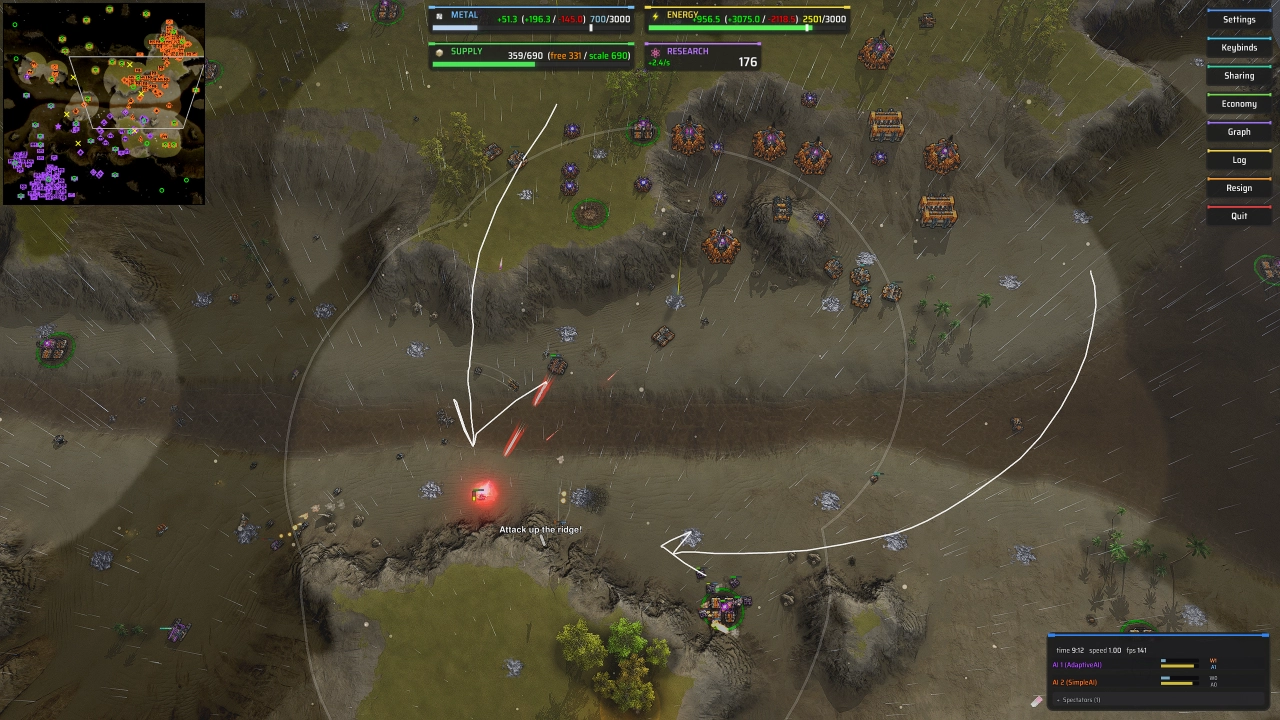 Map drawing · two arrows converging on a point is a plan