
Three things govern your economy. Two are resources you spend; one is a ceiling on how much army you're allowed to have. A fourth buys you capability rather than bulk.
Metal
The primary constraint. Everything costs it. Comes from EM Converters on resource locations and from reclaiming wreckage. That is the complete list.
Energy
The enabler, and upstream of metal. Power plants build anywhere. Energy runs construction, weapons — and your converters.
Supply
Not spent, but capped. Every mobile unit occupies supply. Run out and you cannot build more units.
Research
A currency of capability. Metal buys you more; RP buys you better. Tech tiers, converter upgrades, weapons and armour.
Everything is a flow, not a pile
In many strategy games you send workers to collect from a pile of ore, and the pile runs out. Nothing here works that way. Resources arrive continuously, per second, from structures you've built, and keep arriving until those structures are destroyed. Each resource is three numbers on the resources display: income, expenditure, and the stored buffer between them.
You also receive a small trickle of metal and energy simply for being alive. It's not much and you cannot live on it — it exists so that your bad early games are recoverable, not so you can skip building an economy.
EM Converters and resource locations
The map is the economy. Taking ground is taking income. EM Converters can only be built on fixed resource locations. There is no way to build more metal income inside your base. If you want more metal, you go out and hold more of the map.
Converters consume energy and produce metal, continuously, until destroyed. Every converter you add raises your energy demand, so expanding metal always means expanding power at the same time. The most common way new players tie themselves in knots: converters everywhere, no power to match, energy-stall, and the whole economy grinds to a halt.
Rule: every time you place converters, ask what's powering them.
Converters upgrade through four tech tiers, paid with research points. Higher tiers produce more metal and draw more energy to do it — that trade is the whole decision. Expand first, upgrade second. Upgrade when the map is genuinely contested, when you're out of safe locations, or when you have surplus energy and RP.
| Converter tier | Output vs. base |
|---|---|
| Tier 1 | ×2 |
| Tier 2 | ×3 |
| Tier 3 | More than ×5 |
| Tier 4 | More than ×10 |
| Geothermal E→M Converter (on a vent) | Over ×21 — the highest metal output in the game |
Making power
Energy plants build anywhere, which makes energy the part of your economy you control most directly. Build power before you need it: plants take time, and if you wait until you're stalling, you stall for the entire build time. Cheap plants early, big plants later. And since nothing chain-explodes, pack them however you like.
| Tier | Plant | Output |
|---|---|---|
| T1 | Fission Energy Generator | 25 energy |
| T2 | Fusion Energy Generator | 200 energy |
| T3 | Cold Fusion Energy Generator | 1,000 energy |
| T4 | Black Hole Power Facility | 4,000 energy |
| Vent | Geothermal Energy Generator | 350 energy — outperforms Fusion at comparable cost |
Cloaking and shields are free
Neither costs energy — not personal shields, not projected generators, not the Deleter, not cloaking towers. Once built, they simply run. Your energy budget is about converters and construction, not your faction's signature system.
Power scales with everything else
Every converter, every upgrade, every new capability increases demand. Whenever you build anything that draws power, build power in the same breath. Dedicate one constructor to nothing but power plants, all game long.
Geothermal vents
Fixed map features, like resource locations. A vent supports four different structures, and you pick one — so every vent is a choice between power and progress.
| Structure | What it gives you |
|---|---|
| Geothermal Energy Generator | 350 energy |
| Geothermal E→M Converter | The highest metal output of any structure in the game |
| Research Center | Serious RP acceleration — but it consumes more power than the vent generates. A net drain on your grid, not a self-sufficient building. |
| Geothermal Condenser | 2,000 metal and energy storage plus 100 supply, in one building |
Take vents early. A vent you don't hold is a vent your opponent gets to make all four of those choices on.
Supply
Supply is a cap on army size, not a resource you spend. Every mobile unit occupies supply proportional to its value — cheap scouts take very little, heavy units take a lot. Supply Depots raise the ceiling.
When you run out of supply, you stop being able to build units. Not slowly. Not at reduced rate. Your factories sit there with a full metal bank and nothing happens. Nothing looks broken. Watch the supply readout and listen to the voice advisor — it will tell you, out loud, before it becomes a problem.
Supply is also a target. Destroying enemy depots shrinks the army they're allowed to have. In reverse: keep yours spread out and behind your defensive line, not on an exposed flank.
| Structure | Tier | Supply | Storage |
|---|---|---|---|
| Basic Supply/Storage Depot | T0 | +20 | — |
| Medium Supply Depot | T2 | +100 | — |
| Medium Resource Storage Facility | T2 | — | 2,000 metal & energy |
| Geothermal Condenser | Vent | +100 | 2,000 metal & energy |
| Large Resource Storage Facility | T3 | +500 | 20,000 combined |
Storage, stall and excess
Stall is what happens when a resource hits zero and demand exceeds income. A metal stall means every constructor and factory crawls. An energy stall is worse, because energy is upstream of metal: your converters stop producing and a power failure becomes a metal failure a moment later. (Your cloak and shields are unaffected — they don't run on energy.)
Excess is the opposite failure, and it feels fine, which is why it goes unnoticed. If storage is full and income keeps arriving, that income is being thrown away every second. The advisor will tell you you're excessing metal. Believe it.
Storage is far more important than it looks. It's a capacitor: brief spending spikes draw down the buffer instead of stalling you, brief surpluses fill it instead of overflowing, and you can save toward expensive things. Storage produces nothing on its own, but an economy with good storage does noticeably more with the same income.
The healthy state: metal hovering low but not at zero, energy comfortable with headroom, storage never pinned at maximum for long, supply always a little ahead of your army.
Research Points
RP comes from three places: being alive (1 RP per second, always), Research Centers on geothermal vents, and killing things — a percentage of every destroyed unit's metal value comes back as RP.
Fighting well is an economic activity. Every enemy unit you destroy funds your own advancement. Combined with reclaim, a won battle pays you twice: metal from the wreckage, research from the kills. This is the strongest argument against passive play in the game.
RP is spent on Commander tech tiers (which gate everything you can build), converter upgrades, army-wide weapon and armour tracks, and abilities such as scanner sweep. Unspent RP is wasted RP, exactly like floating metal. Check the display every few minutes — arriving at minute twenty holding a fortune you never spent is a genuinely common way to lose.
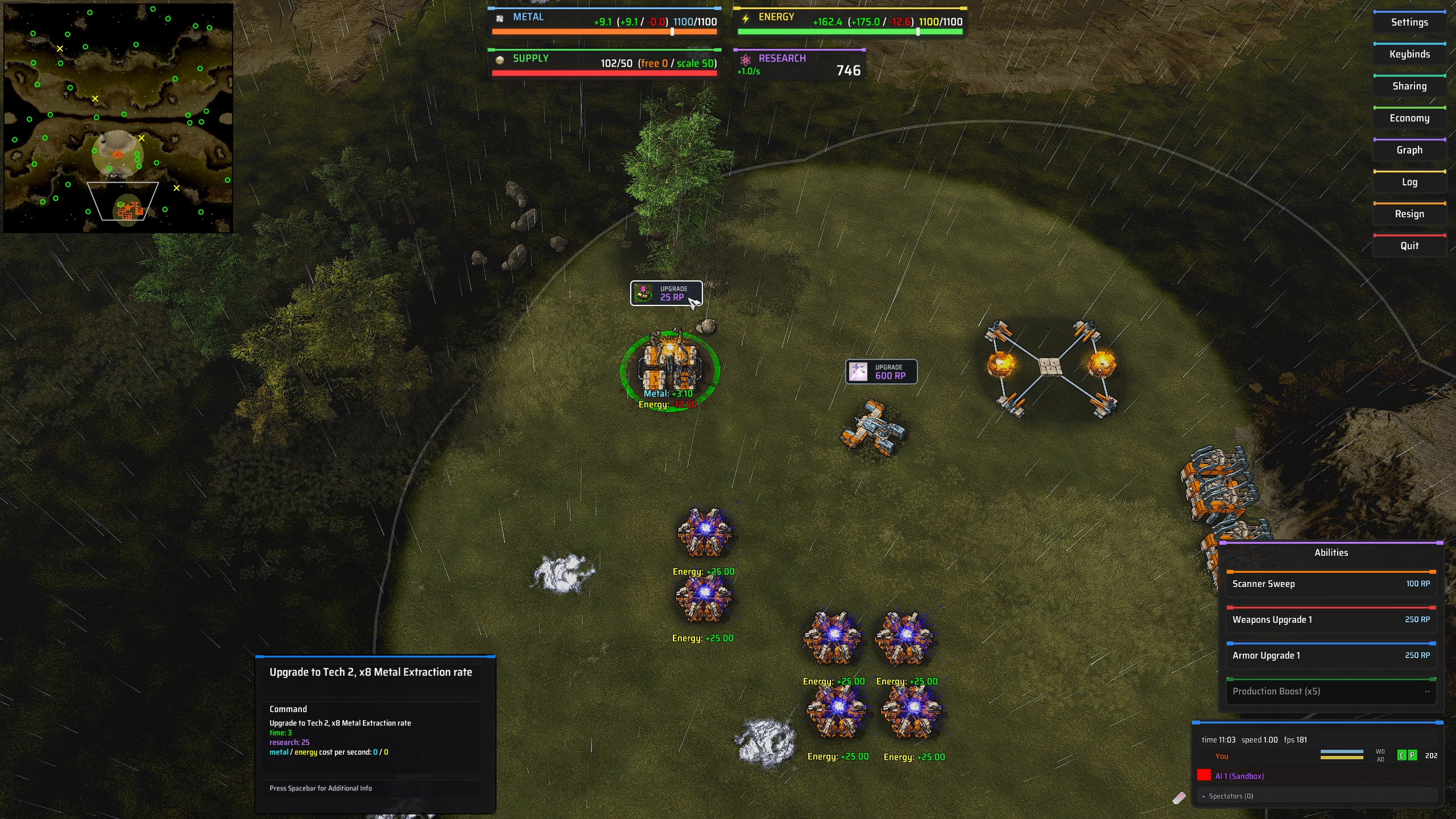 EM Converter with its upgrade button
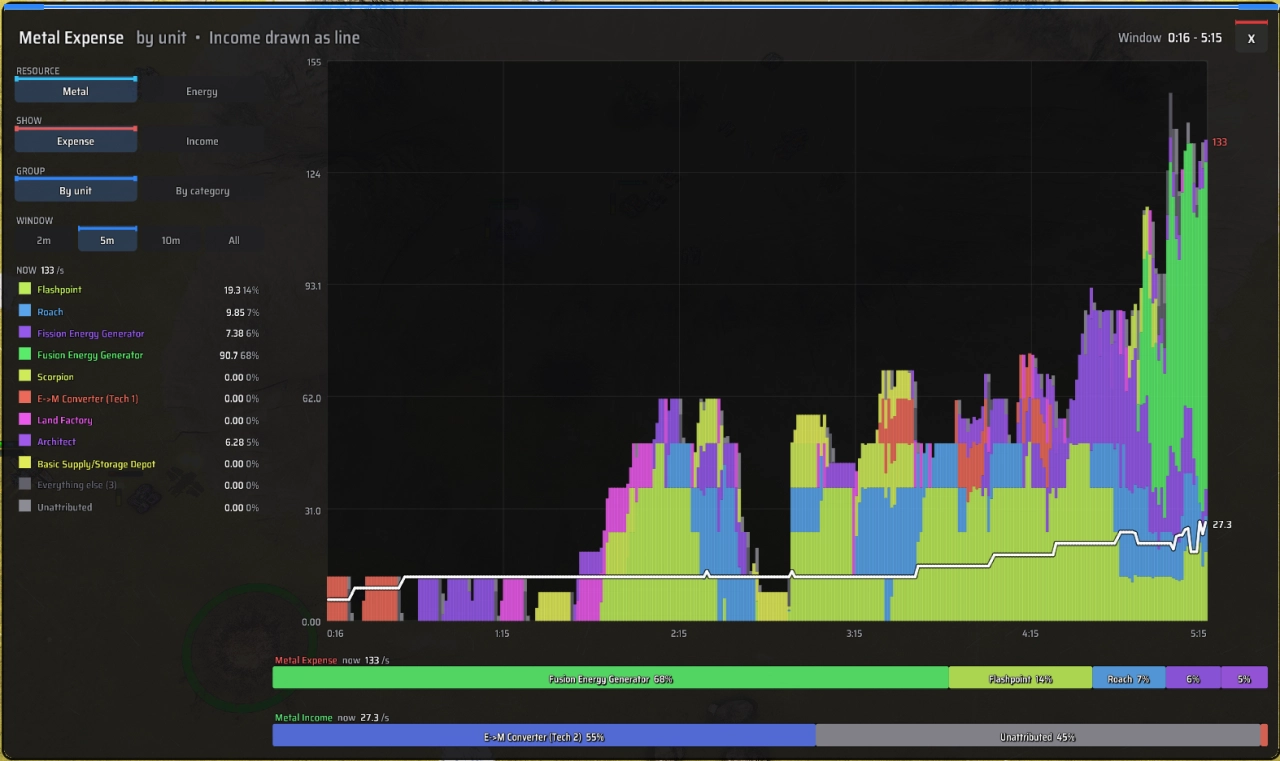 The economy graph · patterns show up in a line that are invisible in a number